Turkey’s position in the global healthcare ecosystem is projected to evolve beyond being merely a cost-effective center by 2026, becoming a “value hub” offering high technology and a holistic patient experience. This transformation presents both significant opportunities and complex financial and administrative challenges, particularly for small and medium-sized enterprises (SMEs) and intermediary organizations.
In this guide, Teolupus analyzes, within the framework of corporate governance standards, how businesses should navigate their roadmap to align with their 2028 vision. The dynamics of the global market in 2026, the quality of treatment for patients, and the 2025 UK Surgical Workforce Census prepared by the Royal College of Surgeons (RCS England) all contribute to this analysis 2025 UK Surgical Workforce Census. This marks a period in which operational transparency and risk management capacity are also being questioned, as highlighted in the report.

For businesses to maintain their financial sustainability and maximize the benefits of government incentives, “institutionalization” is no longer an option, but an operational necessity. [1]
- New Era and Requirements in Turkish Health Tourism Legislation
- Ministry of Trade Decision No. 5973: Incentive Management
- Global Accreditation: Transforming Trust into a Financial Asset
- Western Market Dynamics: EU and UK (National Health Service/NHS) Adaptation Strategies
- Digital Asset Management and Data Security (KVKK and GDPR)
- Corporate Risk Management and Financial Sustainability
- Theolupus Methodology: A Guide to Institutionalization and Control
1. New Era and Requirements in Turkish Health Tourism Legislation
The year 2026 has gone down in history as the year of a “qualitative leap” in Türkiye’s health tourism regulations. The regulations enacted during this period aim not only to ensure the sector’s growth but also to protect its credibility in global competition. The target of $20 billion in revenue and 6-8 million patients by 2028 has made regulatory compliance a strategic necessity. 2026 has just begun; perhaps the intention is to say 2025?
In particular, the International Healthcare Cooperation regulations that came into effect or were updated in 2026 have redefined coordination between the public and private sectors, paving the way for Türkiye to offer its qualified human resources to the global market in a more integrated manner.[5]
1.1. Health Tourism Authorization Certificate: 2026 Updates
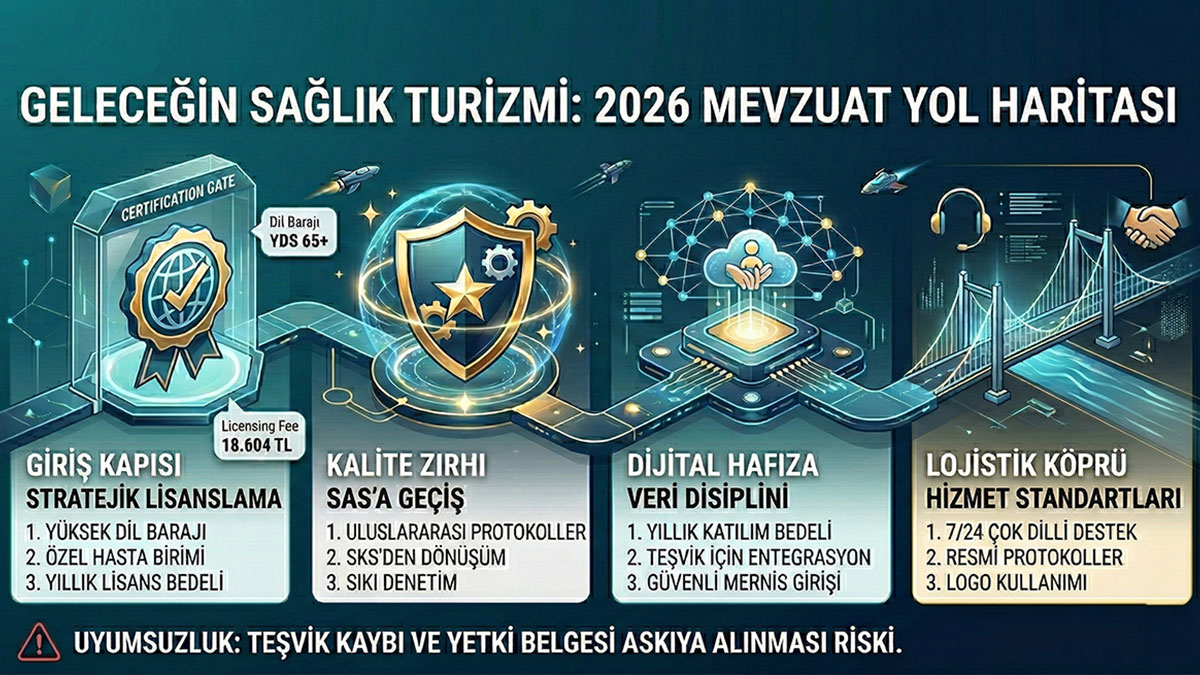
The International Health Tourism Authorization Certificate will cease to be a static permit by 2026 and will become a dynamic license representing an institution’s operational competence and ethical standards. The Ministry of Health has tightened the criteria for obtaining this certificate, increasing both the financial obligations and the frequency of audits. With the Ministry’s approval dated December 31, 2025, the certificate fee for 2026 is updated annually by the Ministry.
True alignment is possible only if the facility updates its “International Patient Unit” structure to meet the 2026 standards. According to the 2026 criteria, foreign language proficiency for personnel working in this unit will no longer be merely a declaration, but a requirement proven by internationally recognized certificates (YDS 65+, TOEFL iBT 78+, etc.).
1.2. Integration of Healthcare Accreditation Standards (SAS)
The year 2026 marks a turning point for Turkish healthcare institutions, truly beginning the era of Healthcare Accreditation Standards (SAS). Current quality certificates. It must be completely replaced by SAS accreditation, issued by TÜSKA, as of December 31, 2026.
SAS is a system recognized by the World Health Organization (WHO) and ISQua, aimed at maximizing patient safety and institutional performance.
1.3. HealthTürkiye Portal: Data Entry and Reporting Discipline
In 2026, the HealthTürkiye Portal, operated by USHAŞ, became the central hub for operational processes in the management of health tourism. The participation fee for the portal has been updated to 120,000.00 TL for 2026.
If a patient’s treatment process is not registered on the portal or their data is incomplete, it is considered “unregistered,” leading to the direct rejection of their incentive applications.
1.4. New Service Quality Criteria for Intermediary Organizations (Agents)
By 2026, intermediary organizations must have a professional call center infrastructure capable of providing 24/7 service in at least two foreign languages. Furthermore, according to the advertising regulations published in November 2025, the use of the “HealthTürkiye” logo in digital advertisements has become mandatory, and to prevent manipulation in “before-and-after” photos, it is required that interaction (likes, comments) be disabled.
2. Ministry of Trade Decision No. 5973: Incentive Management
As of 2026, the Export Support Decree No. 5973, issued by the Ministry of Trade, represents the strongest financial leverage for health tourism businesses. These incentives enhance the global competitiveness of businesses and enable them to overcome market entry barriers.[2]
2.1. New Limits in Digital Marketing and Advertising Support
The maximum stimulus limits announced for 2026 are subject to revision based on annual inflation and policy updates.
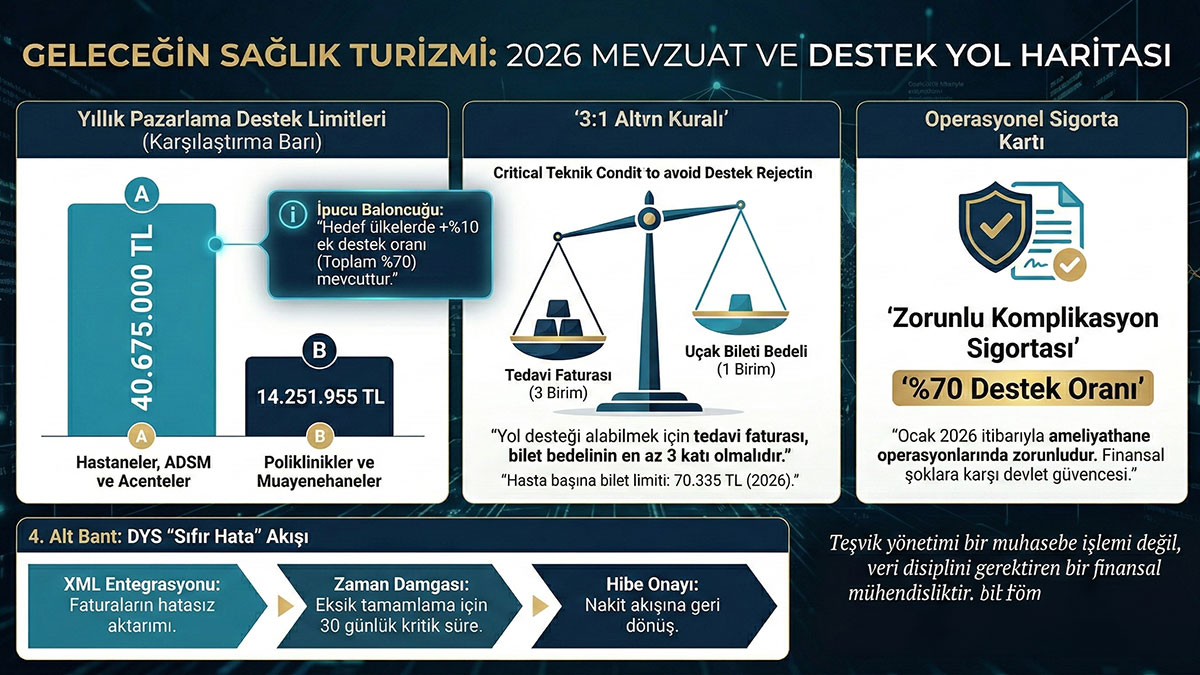
| 2026 Advertising and Promotion Support Limits | Upper Limit (Annual) | Support Rate |
| Hospitals, Dental Clinics, and Agencies | 40.675.000 TL | %60 |
| Polyclinics and Private Practices | 14.251.955 TL | %60 |
The use of enticing phrases such as “discount” or “price advantage” in advertising content will result in the rejection of the invoice.
2.2. Complication Insurance and Patient Travel Expense Incentives
From 2026 onwards, obtaining “Complication Insurance” for surgical procedures will be a legal requirement and will be subsidized at a rate of 70%.
- Patient Transition Assistance: It is supported at a rate of 60% with an annual upper limit of 40,675,000 TL. The ticket limit per patient is 70,335 TL for the year 2026.
- The Critical Rule: To qualify for travel assistance, there must be at least a threefold difference (3:1 rule) between the treatment bill and the ticket price.
2.3. File Tracking Strategies via DYS (Support Management System)
DYS completely phased out manual document acceptance in 2026. Strategic steps to be implemented in this new era include prioritizing the uploading of invoices in XML format and addressing any deficiencies within the 30-day legal period.
2.4. Taking Advantage of Overseas Unit, Office, and Brand Registration Support
For offices opened abroad, 60% support is provided with a limit of 8,542,002 TL per unit annually. Support for overseas brand registration is 3,562,337 TL annually. An “organic link” between the parent company in Türkiye and the overseas unit is required for this support.
3. Global Accreditation: Transforming Trust into a Financial Asset
Global accreditations are considered the strongest “Trust Badge” for Google E-E-A-T signals in 2026.
3.1. JCI (Joint Commission International) Gold Standard Analysis
JCI is the most prestigious accreditation system, monitoring patient safety and ethical standards against more than 1000 criteria. Accredited facilities gain priority access to international insurance networks.
3.2. Temos International: European Focus for Boutique Clinics
Temos is a clinician-friendly system focused on “Medical Tourism” processes, especially for boutique dental, IVF, and aesthetic clinics. Temos accredited institutions are awarded the “Preferred Partner” title by the “Diplomatic Council”.
3.3. Cost-Benefit (ROI) Analysis in Accreditation Processes
The Ministry of Trade supports accreditation costs for organizations like JCI and Temos under the “Market Entry Document Support” program, providing up to 60% support with an annual limit of 10,688,315 TL. Accredited facilities gain 20-35% higher pricing power in package deals.
3.4. International Patient Safety Protocols and Documentation
The accreditation process mandates the documentation of critical protocols such as patient identification, drug safety, and infection control according to world standards. This discipline significantly reduces the risk of malpractice.
4. Western Market Dynamics: EU and UK (National Health Service/NHS) Adaptation Strategies
By 2026, the Western European and UK markets will have become not just “source markets” for Türkiye, but also strategic partnership areas offering solutions to the structural crises of local healthcare systems.
4.1. Cross-Border Health Services Directive (2011/24/EU) and Türkiye’s “Safe Port” Positioning
The European Union’s Directive 2011/24/EU legally guarantees the right of EU citizens to receive treatment in other countries, avoiding long waiting times in their own countries. In 2026, this directive established a legitimacy for destinations like Turkey that provide services at international standards.
4.2. The UK Market: NHS Capacity Bottlenecks and Value-Oriented Healthcare Transfer
As of 2026, the pressure of elective care on the NHS has crossed a historic threshold. According to official data published by NHS England in January 2026, the total number of cases awaiting treatment in the United Kingdom has reached 7.31 million. While the median waiting time in the orthopedics branch has risen to 49 weeks, waiting times in bariatric surgery range between 22 and 34 months. Thanks to its cost and access advantages, Turkey offers a strong alternative in this crisis environment.
4.3. Digital Border Management: Integration of the ETIAS Regime and Health Visa
The European Travel Information and Authorization System (ETIAS), which will be fully operational in the last quarter of 2026, introduces a new travel authorization requirement for UK citizens who are currently visa-free. Türkiye’s response is provided via the HealthTürkiye portal.“Health Visa”It is the (Health Visa) infrastructure; this system speeds up processes by creating a digital bridge between hospitals and consulates.
4.4. Continental European Insurance Models: Direct Billing and Reimbursement Mechanisms
In 2026, European insurance funds (Krankenkasse in Germany, Zorgverzekeraars in the Netherlands) are entering into deeper financial partnerships with accredited hospitals in Türkiye to manage rising local costs. Complication insurance, which will become a critical requirement in incentive processes by 2026, is the most important reimbursement approval criterion for European insurance giants.
5. Digital Asset Management and Data Security (KVKK and GDPR)
In the 2026 health tourism ecosystem, digital assets have gained an “operational center” identity, representing the legal validity and global reputation of the institution.
5.1. Cross-Border Transfer of Personal Data in Health Tourism
The reforms implemented in the KVKK (Personal Data Protection Law) legislation in March 2024 have reached the full implementation stage as of 2026. In this new era, the “Standard Contractual Clauses” (SCCs) system has become mandatory, and a requirement has been introduced to notify the Personal Data Protection Board (Kişisel Verileri Koruma Kurulu) within five business days of their signing.
5.2. E-E-A-T and YMYL Optimization on Websites and Landing Pages
Google’s 2026 search algorithms evaluate health content using a “Medical Board” discipline. Information Gain has become the primary ranking factor, and content supported by PubMed citations and “Medical Schema” markup is prioritized in AI Overviews (IGE) results.
5.3. AI-Powered Patient Triage and CRM Systems
By 2026, “Agentic AI” technology will be able to autonomously manage the entire process, from the patient’s initial symptom analysis (triage) to the integration of medical records into hospital information systems. Strategic CRM management is based on the “Privacy-first” principle with HIPAA and GDPR compliant infrastructures.
5.4. Cybersecurity: ISO 27001 Standards in the Protection of Health Data
ISO 27001:2022 certification has become a testament to global trust by 2026. Furthermore, the NIS2 Directive in the EU market has made cyber incident reporting processes mandatory for Turkish healthcare facilities, classifying them as “indirectly liable suppliers.”
6. Corporate Risk Management and Financial Sustainability
The year 2026 marks a period in the Turkish economy where the “high interest rates – strong Turkish Lira” balance creates intense financing pressure on the real sector. In foreign currency-focused sectors such as health tourism, corporate risk management has become a strategic fuel, determining the growth rate of the business.
6.1. Financial Hedging Techniques Against Exchange Rate Risk
Medical tourism businesses have shifted from passive cash management to proactive hedging strategies to manage exchange rate volatility in 2026. Stabilizing cash flow by using forward contracts to secure future foreign currency income today is now a standard management practice. Options, on the other hand, limit downward exchange rate risk while offering the possibility to protect against potential upside profit opportunities from exchange rate fluctuations.
According to the Teolupus methodology, the most effective way to eliminate financial costs is to match currency-based revenues and currency-based expenses in the same currency (Natural Hedging). Furthermore, dynamic pricing models based on a Currency Basket have been implemented to maintain the capacity to pass on cost increases to patients in 2026.
6.2. Transfer Pricing: Financial Balances Between Hospital and Agency
The presence of both hospitals and intermediary agencies within a healthcare group constitutes the biggest risk area in tax audits in 2026. In light of the increasing frequency of audits by the Revenue Administration, it is mandatory for commission rates between hospitals and agencies to be consistent with those applied by independent organizations in the market (Market compliance/Arm’s Length Principle).
According to Article 13 of the Corporate Tax Law No. 5520, a price difference from the arm’s length price in transactions with related parties is considered “disguised profit distribution” and leads to tax penalties. The “Master File” and “Local File” reporting, which are fundamental audit items in the 2026 audits and adhere to OECD standards, are indispensable for entities with MNE (Minimum Negotiable Instrument) status. This last sentence is unclear; let’s rewrite it clearly and provide explanations if necessary.
6.3. Operational Risk: Malpractice and International Legal Arbitration
In 2026, malpractice claims will be a crucial aspect of crisis management, requiring the protection of international reputation. The strongest defense mitigating a physician’s liability in malpractice cases is photographic and video-verified consent documents taken in accordance with international protocols. Complication insurance, which will become a critical requirement in incentive programs by 2026, protects businesses from financial shocks by covering the costs of complications in the “strict liability” area.
6.4. Crisis Scenarios: Market Diversification in Geopolitical Shifts (Blue Ocean Strategy)
Global trade tensions and visa regime changes in 2026 have made reliance on a single source a risk factor for businesses. To escape the “Red Ocean” competition in the classic aesthetics and dental segment, focus should be placed on niche areas such as complex oncology, biotechnological treatments, and palliative care.
Within the scope of the Blue Ocean Strategy, “at-home monitoring” models supported by wearable technologies and “Health Vacation” Integrations are considered strategic innovations that redefine market boundaries. Agile marketing infrastructures, which enable the rapid deployment of digital assets to new target markets during unexpected geopolitical crises, are considered a critical determining factor for sustainability after 2026.
7. Theolupus Methodology: A Guide to Institutionalization and Control
The success of health tourism businesses in 2026 and beyond will stem not only from medical expertise but also from the robustness of the corporate architecture that supports this expertise. The holistic methodology we have developed at Teolupus aims to transform these businesses from mere “family clinics” into globally competitive “corporate health groups.”
7.1. Internal Audit: Minimizing the Risk of Incentive Rejection to Zero
Tax and incentive audits in 2026 will focus on “substantive data accuracy” rather than “formal compliance.” During this period, internal auditing is not only a control mechanism for a business but also a risk shield that enhances financial credibility. According to industry practices, for a successful incentive process, internal auditing should continuously monitor at least the following critical points:
- Data Discrepancy Analysis: To instantly detect inconsistencies between invoices uploaded to the DYS system, MERSİS records, and patient entries in the HealthTürkiye portal.
- Documentation Quality: Tracking the timestamps of notifications sent via KEP (Registered Electronic Mail) and maintaining the readability of digital documents according to legal standards.
- Regulatory Compliance Audit: In accordance with Circular No. 49, if the health tourism income deduction exceeds 500,000 TL, the risk of incentive rejection can be minimized by planning the required certified public accountant (CPA) certification processes in advance.
7.2. ERP Integration: Unification of Financial and Operational Data
In 2026, AI-powered automation systems will represent the pinnacle of digital transformation. The ERP infrastructure we propose at Teolupus integrates the entire process, from the patient’s initial contact to the approval of the incentive file, into a single data pool.
The strategic advantages provided by this integration are:
- Ambient Admin: Minimizing administrative errors and directing staff towards high-value patient care processes through agents that autonomously handle medical secretarial and filing tasks. Let’s add the Turkish translation before Ambient Admin.
- Real-time Decision Support: By matching data from wearable technologies (IoMT) with the Electronic Health Record (EHR), we can analyze the patient’s risk profile before they come to Türkiye and proactively manage the risk of complications.
- Bureaucracy Management: Maximizing operational speed in markets where waiting times are critical, such as the UK (NHS), by accelerating data flow between stakeholders (hospitals, agencies, insurance companies) through digital protocols.
7.3. Management Consulting: Transition from Family Business Structure to Corporate Health Group
The Turkish health tourism sector is largely based on family businesses. However, market conditions in 2026 necessitate a shift from emotionally driven decision-making to merit-based and data-driven boards of directors.
The Teolupus management consulting process begins with a comprehensive “Check-Up” that analyzes the organization’s current structure. The following steps are essential in the journey towards institutionalization:
- Governance Configuration: In accordance with the Turkish Commercial Code (No. 6102), the responsibilities of the board of directors should be clarified, independent members should be appointed, and expert committees, such as the “Early Risk Detection Committee,” should be activated.
- Process Optimization: Preserving the company’s legacy while reliably adapting a “closed-loop” management approach that restricts access to outside talent for professional roles to meet specific needs.
- Focus on Sustainability: Recognizing that corporate reputation is of invaluable worth, we aim to integrate transparent communication channels and high standards of care into our corporate culture.
We are your strategic partner in the future of the health tourism ecosystem.
On the path to Turkey’s 2028 vision, adapting to this complex regulatory and financial management set in 2026 will ensure not only your business’s survival but also its status as a global leader. At Teolupus, we guide healthcare organizations and agencies across a wide range of areas, from regulatory compliance and incentive management to financial hedging and corporate risk analysis.
The framework presented in this guide serves as a strategic reference for organizations aiming for institutionalization in the field of health tourism. A customized assessment for your organization. Let’s work together to plan expert consulting support for the audit processes.
Teolupus Assurance Services and Management Consulting

Atıf Yapılan Çalışmalar
- Türkiye sağlık turizmindeki payını artırmayı hedefliyor: 2028 hedefi 20 milyar dolar, Erişim tarihi: February 19, 2026
- Türkiye’nin sağlık turizmi gelirinin 2028’de 20 milyar dolara yükseltilmesi hedefleniyor, Erişim tarihi: February 19, 2026
- HealthTürkiye Portal Üyeliği İçin Son Tarih: 26 Ekim 2025 – Özel Hastaneler Platformu, Erişim tarihi: February 21, 2026
- Sağlıkta Akreditasyon Standartları (SAS) Belgesi Nedir?, Erişim tarihi: February 19, 2026
- Uluslararası Sağlık Hizmetlerinde İş Birliği Yönetmeliği – Konsolide …, Erişim tarihi: February 17, 2026
- Sağlık turizminde yeni dönem Resmi Gazete’de, Erişim tarihi: February 22, 2026
- Uluslararası Sağlık Turizmi ve Turistin Sağlığı Hk. Yönetmelik Yayınlandı., Erişim tarihi: February 17, 2026
- Sağlık Turizminde Çıta Yükseliyor: Hedef 20 Milyar Dolar, Erişim tarihi: February 19, 2026
- 2025 UK Surgical Workforce Census, Erişim tarihi: February 21, 2026
- Second biggest drop in NHS waiting list in 15 years amid record number of patients, Erişim tarihi: February 19, 2026